"Dr. Armstrong, this isn’t working.”
Over the years, I have had nurses come into my office, close the door, and tell me something they weren’t sure I wanted to hear. Sometimes it was a concern about a process. Sometimes it was frustration with a decision. Sometimes it was simply, “Dr. Armstrong, this isn’t working.”
It isn’t just what they said. It’s that they were willing to say it.
That kind of honesty doesn’t begin when someone walks through your door. It begins in all the interactions that came before it. Did I listen the last time? Did I follow through? Could they disagree with me without paying a price for it? Had I shown them that telling me the truth was worth the risk?
By the time someone needs to speak up, the answer to those questions has usually already been written.
IN THIS ARTICLE | 6-MINUTE READ
- Why knowing about psychological safety hasn’t been enough
- The respect gap: what data from 2.3 million healthcare workers reveals about bedside nurses
- How social capital is built (and spent) in ordinary, everyday moments
- Practical language and three small steps you can take this week
We Know Better. So Why Aren't We Consistently Doing Better?
Healthcare has been talking about speaking up, Just Culture, teamwork, communication, and psychological safety for years. We have tools, policies, reporting systems, safety huddles, awareness days, and training.
That raises a more useful leadership question: Is this really a knowledge problem? Or have we underestimated how much the decision to speak depends on what people believe will happen after they do?
Recent research suggests that knowing nurses should speak up is not enough. A qualitative metasynthesis published online in the Journal of Advanced Nursing reviewed 15 studies of nurses’ speaking-up experiences1. Nurses remained concerned about negative responses, while hierarchical structures and poor work environments were identified as barriers to speaking up. Professional responsibility and a supportive atmosphere helped facilitate it.
Psychological safety also appears to influence what happens beyond the decision to speak. In a study of 867 U.S. hospital nurses, higher psychological safety was associated with greater job satisfaction, lower intention to leave within the next year, and more favorable patient-safety ratings2. Importantly, communication openness mediated those relationships, reinforcing the connection between feeling psychologically safe and being willing to communicate openly.
The Missing Piece Is Social Capital
Psychological safety does not appear because a leader says, “My door is always open.” Teams learn whether it is safe to speak through repeated experiences with their leaders and one another.
Healthcare leaders invest heavily in financial capital and human capital. Press Ganey’s recent report, Activating Your Social Capital Strategy, makes the case that a third kind, social capital, often goes unmanaged, and that without it even the strongest investments fall short.3 The part I find most hopeful: unlike money or staff time, social capital is strengthened with use. Every time you listen well, follow through, or tell the truth, you aren’t spending trust. You’re compounding it.
There is also a longstanding body of literature connecting these behaviors to social capital. In Nurse Leader, Gilbert described the importance of shifting from transactional leadership to leadership that fosters relationships to build sustainable healthy work environments grounded in shared governance4. When accomplished, teams improve overall human capital, staff retention, and patient care. Although the social capital of nurse leaders alone cannot impact every performance metric, performance cannot be improved and sustained without it.
WHAT I MEAN BY “SOCIAL CAPITAL” Social capital is the trust and relational equity we build with people over time through repeated experiences of listening, following through, telling the truth, and showing people that their voice matters.
The Respect Gap Nurse Leaders Can't Ignore
THE RESPECT GAP
Senior leaders: 4.43 out of 5
Bedside RNs: 3.72 out of 5, the lowest of any role in the analysis
Sit with that for a moment. The people we most need to speak up about safety are the least likely to say they feel respected. The same data shows frontline staff often rate their own teams favorably, yet feel “us vs. them” toward other departments and have low confidence in senior leadership.4 A nurse can feel safe with the colleague beside her and still hesitate to raise a concern that has to travel across or up the organization.
And this is not only a culture issue. It shows up in outcomes:3
- Organizations in the top quartile for “this organization treats employees with respect” are 3x more likely to earn top-quartile patient ratings for likelihood to recommend the hospital.
- Organizations in the top quartile for teamwork are 50% to 80% more likely to be top-quartile performers on NDNQI® measures such as pressure injuries, CLABSI, and CAUTI.
- Across all settings of care, the #1 driver of patients’ likelihood to recommend is “the care team worked well together to care for me.”
Social capital is not a soft skill sitting off to the side of quality and safety. It is upstream of both.
Trust Is Built in Repetitions
The annual engagement survey does not create trust. Neither does a poster about speaking up. Leadership is a relationship.
Trust is accumulated, or depleted, in ordinary interactions that happen every day.
- Someone raises concerns. What happens next?
- Someone challenges a decision. Does the leader become defensive or curious?
- Someone admits an error. Is the first response learning or blame?
- Someone offers an idea that cannot be implemented. Do they hear why?
- Someone reports a recurring barrier. Does anything change, and does anyone close the loop?
Over time, those repetitions answer two questions for the team: Is speaking up safe? And is it worth the effort? Your team needs proof that it is safe to tell the truth and that telling the truth changes something.
Where Is Your Social Capital Strong, and Where Is It Thin?
- Bonding (within your team): Can your nurses disagree with one another safely?
- Bridging (across departments): When a concern involves pharmacy or the ED, does it get raised, or stop at your unit’s door?
- Alignment (across levels): Do your nurses believe what they tell you will reach senior leadership, and matter when it does?
Pay Attention When Good People Go Quiet
If your best people stop speaking up, do not automatically assume they stopped caring. Silence is information. It may signal that people have learned their input will not change anything, that raising concerns carries interpersonal risk, or that the effort no longer feels worthwhile.
Leaders can respond by becoming curious about the environment and the team’s recent experiences rather than immediately labeling the behavior as disengagement.
Featured Article
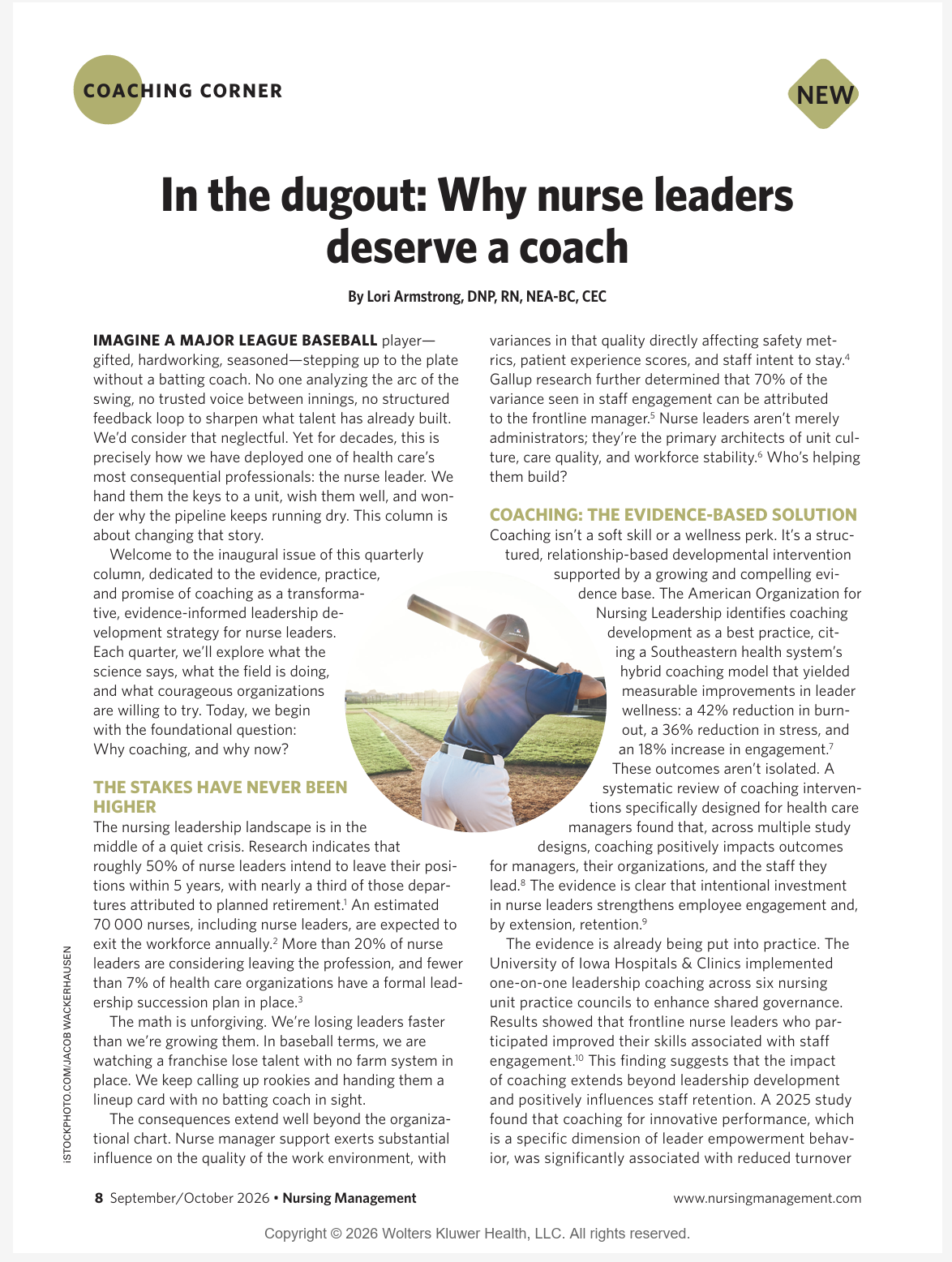
By Dr. Lori Armstrong, DNP, RN, NEA-BC, CEC
In my Nursing Management article, "In the dugout: Why nurse leaders deserve a coach," I explore what happens when the people responsible for supporting everyone else have someone in their corner, too. Leadership coaching gives leaders space to examine how they are showing up, work through difficult situations, and continue developing the behaviors that shape the environments their teams experience.
Close the Loop
One of the clearest ways leaders can reinforce speaking up is to show people what happened after they used their voice. Closing the loop does not mean every suggestion is implemented or every concern has an immediate solution. It means people are not left wondering whether anyone listened.
PRACTICAL LANGUAGE "I heard you. Here's what we looked at. Here's what we're doing. Here's what we cannot change right now, and here's why."
- Connect to core values
- Collect concerns
- Check for understanding
- Commit to follow-up
Yes, Respect Can Move
3 Repetitions to Start This Week
- Ask one better question. In your next huddle or round, ask, “What’s one thing getting in your way that I might not know about?” Then let the silence do its work.
- Close one open loop. Pick a concern someone raised in the last month and go back with an update, even if the answer is “not yet.”
- Build one bridge. Reach out to a leader in a department your team struggles to work with and ask how you can make the handoff between your teams easier.
Final Thoughts
I think back to those closed-door conversations differently now. The most important thing wasn’t that someone trusted me in that moment. It was that we had built enough trust before the moment arrived.
That’s social capital. And in healthcare, we can’t wait until something is at risk to start building it.
Your team is learning every day whether it’s safe to tell you the truth. What are your repetitions teaching them?
How Inspire Nurse Leaders® Can Help
Creating a culture of trust starts with leaders who have the space and support to examine how they communicate, respond, make decisions, and lead through difficult situations.
Inspire Nurse Leaders® offers various pathways designed to meet leaders where they are:
Targeted Leadership Coaching provides focused support around specific leadership challenges, including communication, team dynamics, conflict, executive presence, and leading through change.
Career Insight Coaching helps nurse leaders step back, consider what’s next, and move forward with greater confidence in their leadership journey.
Workshops focused on building trust and identity to improve teamwork and bridging across departments and systems.
References
- Lee E, De Gagne JC, Randall PS, et al. Experiences of Nurses Speaking Up in Healthcare Settings: A Qualitative Metasynthesis. Journal of Advanced Nursing. 2025;81(11):7464-7479. doi:10.1111/jan.16592.
- Cho H, Steege LM, Arsenault Knudsen ÉN. Psychological safety, communication openness, nurse job outcomes, and patient safety in hospital nurses. Research in Nursing & Health. 2023;46(4):445-453. doi:10.1002/nur.22327.
- Press Ganey. Activating Your Social Capital Strategy. Press Ganey Associates LLC; 2026.
- Gilbert, JH. Investment in social capital to mitigate nursing shortages post-pandemic. Nurse Leader. 2023;21(1):69-74. doi: https://doi.org/10.1016/j.mnl.2022.10.011