Two nurse leaders walk into a budget meeting.
On the same day, at the same health system.
The first asks for an additional FTE on a med-surg unit that’s been running short. She talks about morale. She talks about safety. She talks about the fact that her team is exhausted, and she’s not wrong about any of it. Finance nods, thanks her for the context, and tells her they’ll take it under advisement. The request doesn’t make the final cut.
The second asks for something almost identical: protected orientation hours for a unit with a rough first-year retention problem. But she opens with the numbers that tell a story. She shares what the unit’s turnover cost the organization last year, what the orientation hours would cost this year, and what she projects it would save. The manager presents a pilot timeframe to ensure the impact aligns with what she predicts and commits to reporting back. Finance asks a few clarifying questions, and the line item survives.
Same system. Same budget season. Same good intentions. Different outcome.
The difference wasn’t the merit of the ask. It was whether the ask had been translated into a language finance already trusts. This post is about making that translation, not as a one-off exercise, but as a repeatable skill every nurse leader can build.
Nurse leaders are fluent in a values-based case: this keeps patients safe, this keeps nurses at the bedside, this is the right thing to do. All of that is true. It’s also, on its own, rarely enough in a room that runs on numbers.
Here’s the reframe worth sitting with: the return on almost every retention and quality investment you’d want to make is already sitting in your unit’s data. Your turnover trends. Your missed-care incidents. Your quality metrics. Your volume and supply patterns. The work of a strong budget request isn’t inventing a case. It’s surfacing one that already exists and putting it in terms your finance partners can act on.
Why This Budget Season Rewards the Leaders Who Show Their Math
The financial backdrop for this year’s budget conversations makes that translation more valuable than ever.
National RN turnover currently sits around 17.6%, and each RN departure costs a hospital roughly $60,090, meaning a single percentage-point change in turnover swings the average hospital’s costs by close to $295,000 a year (NSI Nursing Solutions, Inc., 2026). That figure alone is the denominator behind nearly every retention ROI calculation in this post, and it’s worth keeping close at hand.
The premium-labor math tells a similar story. Travel and agency RNs currently average around $91 (bill rate) an hour, compared to roughly $59 an hour (including fringe) for employed staff, a built-in comparison point any time you’re weighing a retention investment against the cost of backfilling with contract labor (NSI Nursing Solutions, Inc., 2026).
Meanwhile, the broader financial climate is tightening. Hospital expenses (labor, supplies, pharmaceuticals) are rising an estimated 5–7% year-over-year, while patient volumes in many markets are flat or softening, compressing operating margins (Asser, 2026). Finance leaders aren’t approving requests less carefully this year. They’re approving them more carefully, and that scrutiny isn’t the enemy. Finance’s job is to protect the financial stability that keeps the organization able to deliver care at all, and they’re not the “bad guys” for taking that seriously. Which means the leader who arrives with a documented return has a real advantage over the leader who arrives with a values-based appeal alone.
The Framework: A Simple ROI Formula for Budgeting for Quality
Here’s the good news: you don’t need a finance degree to build this case. You need one formula, and a clear example of how to apply it.
The formula: ROI (%) = (Value Generated − Cost of Investment) ÷ Cost of Investment × 100
Every budget request you make (an FTE, protected education hours, a coaching investment, a change to your supply par levels) can run through this formula. The only variable that changes is what counts as “value” in each case. Here’s what that looks like in practice.
Financial ROI: What the Investment Costs Versus What It Saves (or Avoids)
Take the cost of what you’re asking for, and set it against the cost of what it prevents.
You are requesting funding to add one Care Assistant position to every night shift in your department to reduce the prevalence of hospital-acquired pressure injuries (HAPI). The rate of HAPIs has increased over the past 3 years, and last year, we had 15. During our recent audits, we noticed that our patient mobility significantly reduces overnight. When discussed on leader rounds, staff shared that they do not have enough people to help with patient turns or ambulation, leading to missed care. On review of each HAPI, 12 of the 15 were deemed “preventable” if the appropriate care had been delivered in a timely manner.
Our ultimate goal is to reduce HAPIs, and to do that, we need to increase mobility. We cannot guarantee that adding a Care Assistant will reduce (or avoid) HAPIs, but a data-driven approach can reliably give confidence.
A Care Assistant working every 12-hour shift, 7 days per week, totals 84 hours. At our hospital, this night shift position, on average, earns $19 per hour plus 25% for fringe (or benefits), totaling $23.75 per hour. Additionally, the position will require non-productive time (education, orientation, meetings). Estimating this to be 15% of the total worked hours, an additional 655.2 hours will be budgeted annually. In total, adding one Care Assistant to night shift each day will cost about $119,301 per year.
In a 12-hour shift scheduling model, one 12-hour shift 7 days a week is equal to 2.1 full-time equivalents (FTE). Adding 15% for education, orientation, and meetings will total about 2.4 FTE.
- 12 hours x 7 days per week = 84 hours
- 84 hours / 40 hours per week = 2.1 FTE
- 2.1 FTE + 15% = 2.4 FTE
One HAPI is estimated to cost $10,708 and add 2.2 days to a patient’s stay, on average (Pedula & Delarmente, 2019). Assuming that the added Care Assistant leads to 100% of currently missed care being delivered, reducing the annual count of HAPIs from 15 to 3 (because 12 were “preventable”) would avoid $128,496 in expenses and 26.4 patient days.
Using the Formula: ROI (%) = (Value Generated − Cost of Investment) ÷ Cost of Investment × 100
($128,496 – $119,301) + $119,301 x 100 = 7.7% ROI or $9,168
The Care Assistant will also support patient care outside of HAPI prevention. The cost avoidance may be broader to include reduction in falls, improvement in responsiveness, or enhanced staff satisfaction. The cost avoidance also does not include the lost revenue of the accumulated excess patient days.
In your presentation to the Finance Committee, you will also articulate how you will measure success if the additional 2.1 FTE is approved. Your Process Measure may be “Mobility” and your Outcomes Measure may be “HAPIs”, essentially stating, “If mobility increases then HAPIs will decrease”. A second option for your Process Measure may be “Missed Care”, meaning, “If our frequency of missed care decreases, then HAPIs will also decrease.”
Each month, you will be responsible for illustrating your Process and Outcomes Measures to reflect that investing in the additional Care Assistant is impacting quality of care as predicted. Below is an example of how you may present this data month-over-month.
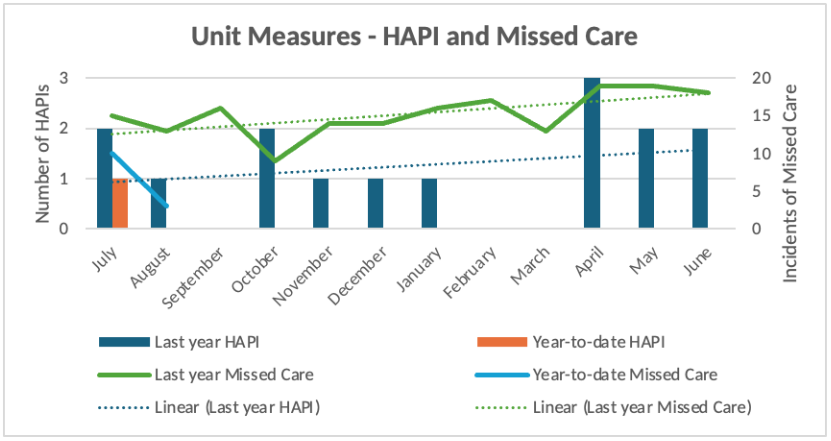
While you may fully expect that the night shift Care Assistant will positively impact HAPIs, you must be objective in your analysis of the impact. If the Care Assistant does not lead to a reduction in HAPIs, you may have to eliminate the FTE and pivot to another intervention.
5 Steps to Build Your ROI Case
The formula and the example above give you the *what*. This is the *how*: a repeatable process for turning a budget-season instinct into a documented case.
1. Establish your baseline.
Pull current turnover, HPPD, skill mix, quality-event, and volume/supply data for the specific unit or program you’re building a case for, and pull it at the unit level, not just the system level. System-wide averages tend to hide the units quietly absorbing the most risk, which are often exactly the units where your case is strongest.
2. Define the specific investment.
Name the exact ask, whether that’s one FTE, a defined number of protected education hours, a coaching line, or a revised par level, rather than a general request for “more support.” A specific ask is easier to cost, easier to measure, and easier to approve than a broad one.
3. Project the value.
Combine cost avoidance (turnover, quality events, waste) with any revenue or reimbursement protection into a single projected-value figure, using the same cost-versus-avoided-cost approach from the example above.
4. Set a measurement window.
Commit to 6 to 12 months up front. This reframes the request as a pilot with built-in accountability, which is a far easier “yes” than an open-ended, permanent line item, and it gives you a natural checkpoint to adjust course if the early data looks different than projected.
5. Monitor and report back.
Close the loop with actual results at the end of your window, whether they matched your projection or not. This year’s ROI case becomes next year’s evidence, and next year’s easier conversation. Leaders who report back build a track record; leaders who only ask, don’t.
What Proving ROI Is Not
It’s not padding numbers to win the room. Your credibility depends on honest, defensible estimates, including the caveats, like the one built into the pressure injury example above, that keep your projections grounded in what the evidence actually supports.
It’s not a one-time pitch. The leaders who build ongoing credibility with finance are the ones who report back, not just the ones who ask well.
It’s not only about dollars. Some clinical and operational value is harder to monetize precisely than others, and that’s fine. Name it plainly even when you can’t fully quantify it, rather than forcing false precision.
And it’s not solely nursing’s job to build the case, or solely finance’s job to evaluate it. The strongest ROI cases come out of a genuinely joint conversation, not a one-way pitch delivered into a room. Discuss the request with your finance partner ahead of the pitch to gain insight and feedback. A case that’s already been stress-tested is likely to be more successful.
The Compounding Return
There's a return here that doesn't show up in any spreadsheet: trust.
The first ROI case you bring to finance is the hardest. You’re building the muscle, gathering data you may not have pulled together this way before, and making a case in an unfamiliar format. But every case after that gets easier, because you’ve demonstrated something your finance partners will remember the next time you walk into the room: you show your work.
That’s the compounding return of budgeting for quality. A single well-documented ask protects one line item. A consistent practice of building these cases changes how finance hears every request you bring them going forward.
Quick Reference: The Math Behind This Case
ROI (%) = (Value Generated − Cost of Investment) ÷ Cost of Investment × 100
- The ask: $119,301 for 2.4 FTE of night-shift Care Assistant coverage
- The avoided cost: $128,496 from reducing preventable HAPIs from 15 to 3
- The net return: $9,168, plus reduced patient days and stronger mobility outcomes
Back to the Budget Meeting
Go back to the two nurse leaders from the beginning of this post. The difference between them was never the size of the ask. It was whether the ask came with a number finance could already trust. The Care Assistant example above shows exactly what that number looks like in practice: a clear cost, a clear return, and a plan to report back.
That’s the model to bring into your own budget conversation this season, whatever your specific ask turns out to be. Budgeting for quality is not about asking for more. It’s about proving the return that’s already there, and showing your work along the way.
How Inspire Nurse Leaders® Can Help
Building a strong financial case is a skill, and it is one nurse leaders can develop.
At Inspire Nurse Leaders, we help nurse leaders strengthen the financial acumen needed to connect clinical priorities with organizational goals. Through customized workshops and leadership development, we make financial concepts practical and relevant to the decisions nurse leaders face every day.
From building a budget and demonstrating ROI to understanding the financial impact of quality, staffing, and retention decisions, we help leaders become more confident partners in conversations with finance and executive teams.
Ready to build financial acumen across your leadership team?
References
NSI Nursing Solutions, Inc. (2026). 2026 NSI National Health Care Retention & RN Staffing Report. https://www.nsinursingsolutions.com/documents/library/nsi_national_health_care_retention_report.pdf
Asser, J. (2026, March 26). Hospital finances reckon with volume drop, persistent costs to start 2026. HealthLeaders.
https://www.healthleadersmedia.com/ceo/hospital-finances-reckon-volume-drop-persistent-costs-start-2026
Padula, W.V. & Delarmente, B.A. (2019). The national cost of hospital-acquired pressure injuries in the United States. International Wound Journal, 16(3), 634-640. doi: 10.1111/iwj.13071